As an Amazon Associate, I earn from qualifying purchases. This post may contain affiliate links.
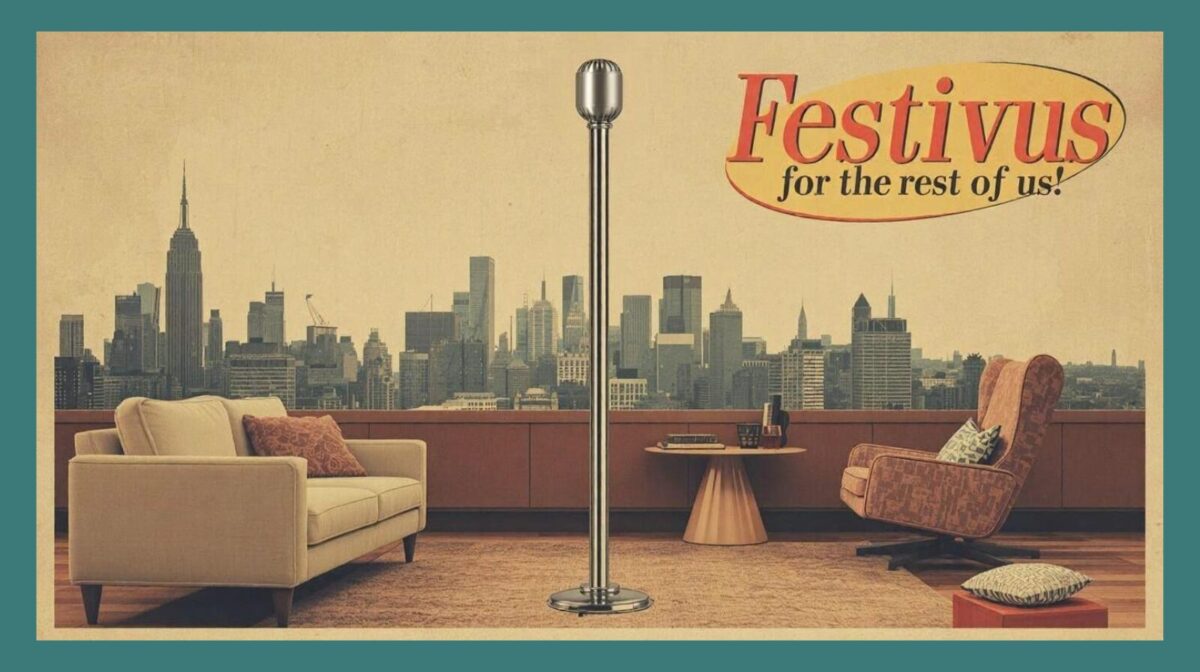
Every December, right around the time someone sends the first “friendly reminder” about a Secret Santa exchange, my brain drifts back to an aluminum pole with “a very high strength-to-weight ratio.” That’s the power of Festivus. The moment holiday expectations start piling up, I can hear Frank Costanza shouting in the distance, and suddenly everything feels lighter.
I watched the Festivus episode when it first aired in 1997, sitting in the family room with my parents and sister, all of us already deep into our Seinfeld quoting era. We didn’t know that “Festivus for the rest of us!” was about to join the family lexicon along with all the other quotable Seinfeld lines, but it stuck fast. Even now, when December rolls in, the joke resurfaces without anyone planning it. Someone says “It’s almost Festivus,” someone else answers with “Festivus for the rest of us,” and we all end up laughing like we did in the living room back in the ’90s.
The beauty of Festivus is that it’s both completely ridiculous and just believable enough. When George’s dad swaps the tree for an aluminum pole, trades warm togetherness for the Airing of Grievances, and finishes the night with Feats of Strength, it’s so over the top that my family could only laugh. We’d never behave like that, but we also knew plenty of families who probably could.
Watch: “The Story Of Festivus”
This quick five-minute recap from the official Seinfeld channel covers the complete saga of Festivus, including Frank Costanza’s holiday meltdown, the aluminum pole, the Airing of Grievances, and the delightfully offbeat family dinner that made the holiday iconic.
Video via Seinfeld on YouTube
In our house now, December is quieter than it used to be. Since moving to the Midwest in 2019, our holidays look more like slow mornings, make-ahead breakfasts, and stockings set outside bedroom doors, even though the kids are fully in (or close to) the adult zone. We keep decorations minimal, mostly because by December 27 the house starts to feel cluttered. It’s peaceful, but even peaceful months have their moments. That’s where the Festivus jokes come in. Not because we’re airing complaints at one another, but because our whole crew can laugh about the absurdities happening around us. It’s less grievance and more shared eye-roll, wrapped in a Seinfeld reference.
Festivus still resonates because it captures a very specific December feeling. The one where you’re juggling work deadlines, wrapping gifts at midnight, and trying to remember which family member likes which breakfast casserole. That mix of warmth and low-key chaos is familiar. Holiday burnout wrapped in twinkle lights. Festivus gives all of that an easy shorthand.
It’s a Festivus miracle!
Cosmo Kramer, “The Strike” (Season 9, Episode 10)
Even at work, the reference sneaks in. The people who get it jump right in with their own GIF or quote, and the ones who don’t just … pause. In smaller meetings, I’ve learned to ask, “Are you a Seinfeld watcher?” before I toss out a line, which saves everyone from that confused stare.
Pop culture hasn’t let go of Festivus either. It shows up every year in memes, office jokes, and novelty sweaters. All sorts of Seinfeld-themed items are still easy to find, from Seinfeld: The Complete Series on Blu-ray and Uno Seinfeld to a “Best of Seinfeld” blanket, “Serenity now!” candle, and novelty gear. There are even Festivus-specific trinkets, — a Festivus board game, Festivus/Seinfeld: Celebration Kit, a Festivus sweater — that can keep the joke alive every December.
What I love most is that Festivus doesn’t ask you to rebel against the holidays. It just lets you admit that they’re a lot, in the most Seinfeld way possible. It’s a reminder that even the most chaotic moments can be funny when viewed through the right lens.
If you want a deeper dive into why Seinfeld still lands decades later, I wrote about that in my post, Why Seinfeld Still Works: The Show About Nothing That Said Everything.
Festivus FAQs
If you want a few quick Festivus basics or you’re refreshing your memory before a rewatch, these FAQs cover the essentials without overexplaining the joke.
What is Festivus?
Festivus is a parody holiday from the Seinfeld episode “The Strike,” featuring an aluminum pole, the Airing of Grievances, and the Feats of Strength.
Why do people celebrate Festivus today?
Most people celebrate it for the humor. It has become a fun way to acknowledge holiday burnout, family chaos, and the shared stress of December.
What episode of Seinfeld is Festivus from?
Festivus appears in Season 9, Episode 10, “The Strike.” If you want to rewatch it, check it out on a streaming service or pick up your own copy of Seinfeld: The Complete Series.
Is Festivus a real holiday?
Not officially, but many people jokingly observe it every December 23. It’s more of a cultural wink than a formal celebration.
What is the Festivus pole?
The Festivus pole is a plain aluminum pole Frank Costanza insists on using instead of a Christmas tree. Fans often buy replicas for parties or office jokes.
Why does Festivus resonate with Gen X?
Gen X grew up watching Seinfeld in real time, and Festivus became a perfect shorthand for holiday stress, family quirks, and the feeling of “too much” in December.