As an Amazon Associate, I earn from qualifying purchases. This post may contain affiliate links.
There was a stretch of time when Saturday mornings had a shape to them. Not a plan, exactly, but more of a flow you could count on.
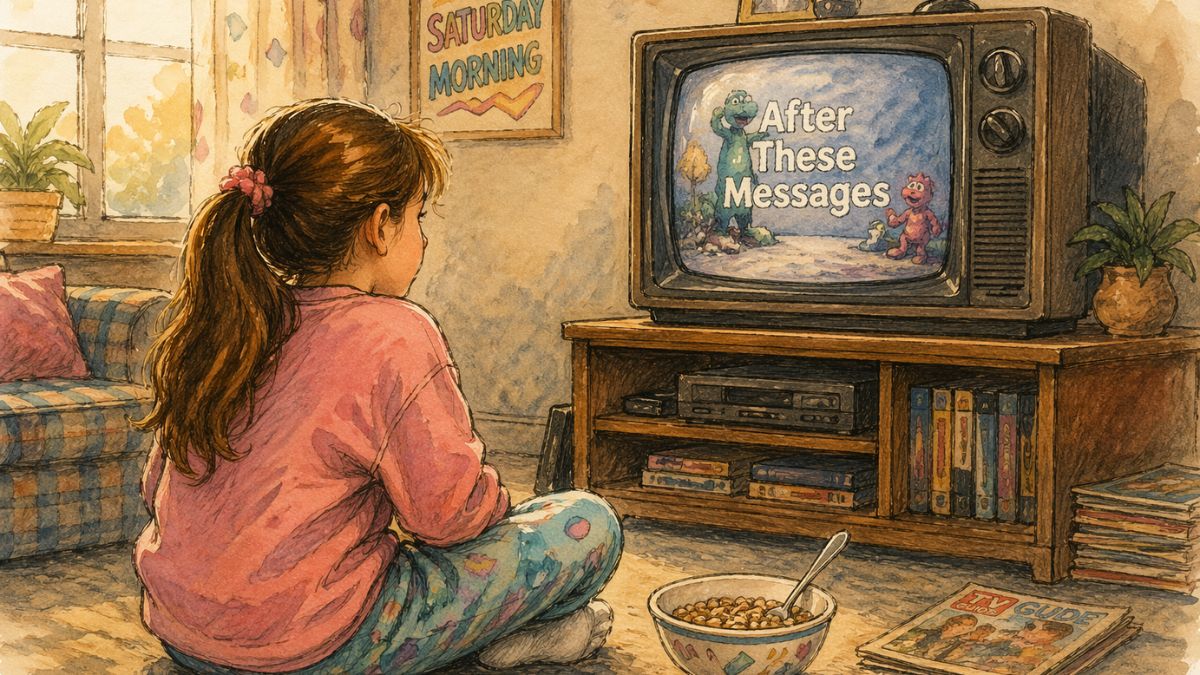
I remember sitting on the floor in the living room with the TV already on, the house still quiet before the rest of the day started. No one else around, or at least no one I remember — just a lineup of cartoons that showed up the same way every week, whether you thought much about it or not.
You didn’t have to decide what to watch because it had already been decided for you, and somehow that lack of choice made it all feel easier. That rhythm was part of what made it stick — something I wrote more about in “Saturday Morning Cartoons in the ’80s and ’90s: Why They Mattered — and Why They Ended.”
The Routine Was the Point
When people talk about the best Saturday morning cartoons of the ’80s and ’90s, the conversation usually goes straight to the shows themselves.
But the shows were only part of it.
There was also the structure around them — the fact that you knew what came on and when, even if you weren’t carefully planning your morning around it. A quick look through TV Guide, a mental note of what sounded interesting, and then settling in for however long you stayed.
It wasn’t an all-morning commitment, and it wasn’t meant to be. At some point, a parent would decide it was enough and send you outside or nudge you toward something else, and you went without much argument because that boundary was part of the routine, too.
The cartoons didn’t define the whole morning — they just anchored the beginning of it.
Did you know? Before on-screen guides and streaming menus, many families relied on printed TV Guide listings to plan what to watch each week, flipping through pages to find favorite shows and map out the upcoming schedule.
The Shows That Pulled You In
I tended to gravitate toward the more action-oriented cartoons, the ones that leaned into fantasy and adventure and felt just a little bigger than everything else on TV at the time, even as more familiar staples like Looney Tunes or Teenage Mutant Ninja Turtles cycled through the broader lineup.
He-Man and the Masters of the Universe, Transformers, and ThunderCats all fit into that category, even if I wasn’t structuring my morning around catching every single episode.
Looking back, they were a little cheesy, and the moral lessons at the end were rarely subtle. Still, they avoided the overly saccharine tone that showed up in some other cartoons at the time, and the sense of adventure was enough to pull you in even in short bursts.
The animation style played a bigger role than I probably realized then, giving those shows a scale that made them feel expansive, even when you were only watching for a half hour before moving on to something else.
It also makes sense now that the genres I still gravitate toward — fantasy, sci-fi, and post-apocalyptic — trace back to that same early pull.
That mix of action and adventure didn’t exist in a vacuum, either. Saturday mornings weren’t made up entirely of cartoons, even if that’s how we tend to remember them now.
Did you know? In the 1980s and early ’90s, major broadcast networks built out dedicated Saturday morning cartoon blocks, meaning millions of kids were watching the same lineup at the same time each week.
There were shows like Picture Pages, You Can’t Do That on Television, The Electric Company, and Sesame Street that blended live action with animated segments, sketches, and recurring bits that felt just as much a part of the lineup.
They weren’t cartoons in the traditional sense, but they fit into the same rhythm. They broke things up, shifted the tone, and added a different kind of energy to the morning without ever feeling out of place.
Everything In Between
The experience wasn’t just about the cartoons themselves, though. A lot of what stuck came from everything that happened in between.
There were public service announcements that somehow lingered longer than the episodes, toy commercials that blurred the line between storytelling and advertising — My Little Pony and Rainbow Brite — and cereal ads that made breakfast feel like part of the ritual instead of something separate from it.
Then there were the transitions, the small details that quietly held the whole experience together. The claymation “After These Messages” bumpers on ABC didn’t stand out at the time so much as they blended into the flow, but they now serve as one of those details that immediately place you back in that era.
If you remember these, you probably don’t need the explanation. But just in case…
Watch: ABC “After These Messages” Saturday morning bumpers
These ABC “After These Messages” bumpers ran between cartoons on Saturday mornings, bridging the gap between shows and commercials in a way that now feels instantly familiar.
Video via ToonORama on YouTube
It wasn’t seamless, and it wasn’t curated, but it was consistent in a way that made it feel dependable.
A Mostly Solo Experience
For something that defined a generation, Saturday morning cartoons didn’t always feel like a shared experience in the moment.
Most of it happened alone, or at least without much conversation around it. It might come up later at a sleepover, when everyone gathered around the TV the next morning, but it wasn’t something we regularly analyzed or compared during the week.
That said, the shows didn’t exist in isolation. They showed up in a different way once you were with friends, especially through the toys that went along with them. We weren’t sitting around breaking down episodes, but we were playing out our own versions of those worlds, pulling from the same characters and storylines in a way that felt understood without needing much explanation.
Instead, it existed more as a personal routine, something you stepped into each weekend without thinking too much about it, which may be part of why it stuck as clearly as it did.
What Made Them the “Best”
If you’re searching for the best Saturday morning cartoons, it’s easy to build a list of familiar titles that show up again and again.
But the reason those cartoons still resonate isn’t just because they were popular or well-made.
They were part of a system that didn’t require much from you — you showed up, the shows were there, and for a little while that was enough. There was no pressure to optimize your choices or to keep up with everything, which gave the experience a kind of simplicity that’s harder to replicate now.
Then vs. Now
What stands out most when you compare that experience to today isn’t what we had, but what we didn’t.
Choice.
Today’s kids have access to an almost endless supply of content, with streaming platforms, viral shows, and algorithms shaping what they watch alongside their own preferences and their parents’ input.
Back then, it was much more straightforward. You either had access to TV or you didn’t, and if you did, you watched what was on. That lack of choice didn’t feel limiting at the time — if anything, it gave those Saturday mornings a built-in rhythm that made them feel grounded.
You didn’t scroll or weigh options, aside from choosing between ABC, NBC, and PBS. You just watched, until someone told you it was time to move on (and head outside).
Did you know? By the late 1990s, traditional Saturday morning cartoon blocks began to disappear as networks shifted toward educational programming and cable channels took over kids’ content.
Still Part of the Routine
Even now, there’s something about that structure that lingers.
Not necessarily the specific shows, but the idea of a small, contained window of time that belonged to you, one that didn’t need to be personalized or optimized to feel meaningful.
It was predictable without being boring, limited without feeling restrictive, and simple in a way that made it easy to return to, at least in memory.