As an Amazon Associate, I earn from qualifying purchases. This post may contain affiliate links.
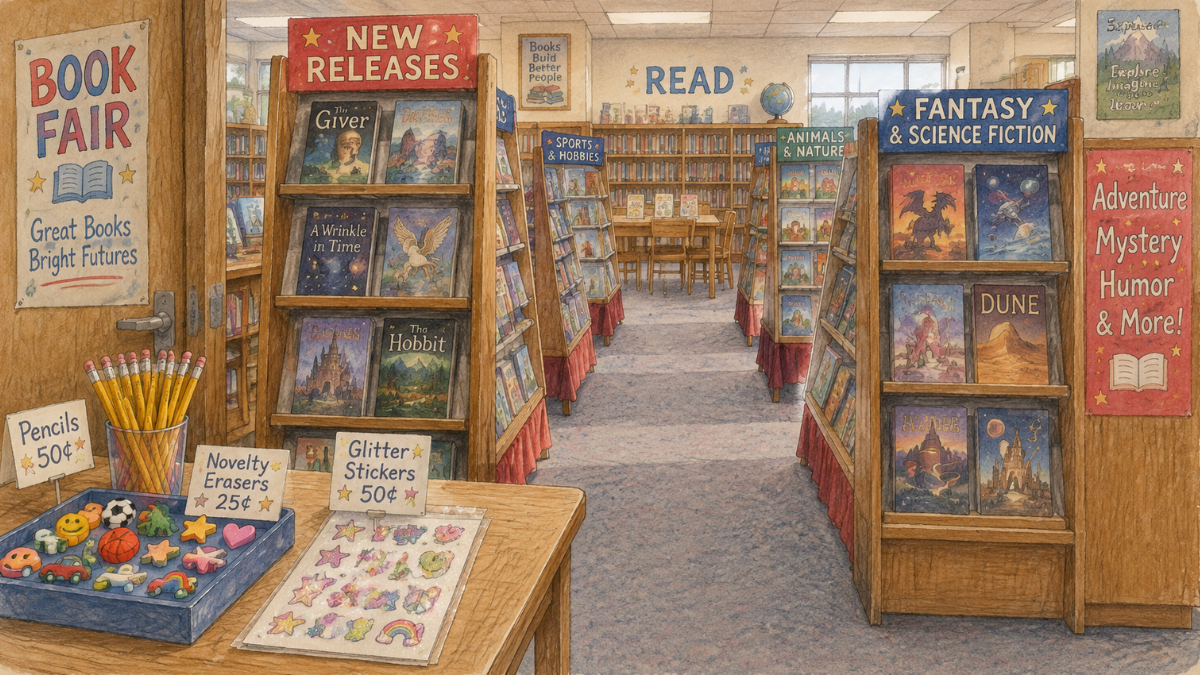
By the time the book fair opened, our teachers had already been talking about it in class. There was a buzz leading up to it, and when I walked into the school library, I understood why. There were tall shelves and aisles where there hadn’t been before. A store had opened in the library.
I remember the posters, erasers, pencils, and stickers. I’m drawing a blank on the actual books I bought, which is a little embarrassing for someone writing about a book fair. But I do remember my shopping strategy: Get as many individual things as possible for whatever cash I was allowed to bring. A book had some stiff competition if the same money could get me a pencil, an eraser, and a sheet of stickers — especially glossy or glittery ones.
It never occurred to me that this was a fundraiser. Selling wrapping paper and chocolate bars felt like fundraising. This was shopping during school!
Decades later, I’m curious how the store got there in the first place. Who brought in the shelves? Who ran the register? And where did my sticker money go?
How Scholastic Took the Book Fair National
By the time Scholastic got into book fairs, it had been selling books through schools for decades. Its first school-based book club dates to 1948. The fairs came in 1981, when Scholastic bought a California book fair operation. Two years later, it bought Great American Book Fairs, a deal Scholastic credits with making it a national operator.
By the mid-’90s, Scholastic was operating fairs in all 50 states. It had 73 U.S. warehouse locations and used a fleet of leased vehicles to get books and display cases from those warehouses to schools. More than two-thirds of the titles it offered at fairs at the time were licensed reprints or books purchased from other publishers. Stocking a fair was a bookseller’s job as much as a publisher’s.
The number that caught my attention was 90%. That’s roughly the share of schools that hosted a Scholastic fair in fiscal 1995 and held one again the following year. By fiscal 1999, book fairs brought in about 30% of the sales in Scholastic’s children’s publishing and distribution division. The company attributed that year’s growth to a combination of more fairs and more sales per fair, helped by a wider selection. A store that opened for about a week at a time had become a substantial business.
Did you know? Scholastic brought costumed book characters to some fairs. In fiscal 1994, the company launched Scholastic Books on Tour, a fair format with a wider selection of titles, special displays, and costumed book characters. It was designed as an event for the whole family.
Who Ran the Store, and Who Got the Money?
Scholastic supplied the books and display cases. The school ran the fair, usually with a librarian or parent-teacher group sponsoring it. Volunteers could set up the displays, take payments, and pack unsold inventory for pickup. Scholastic had the warehouse network and the trucks. The school had the room and the people to turn a delivery into a working store.
The school kept a share of sales. A January 1993 newspaper notice from Bogata, Texas said the school would put 25% of total fair sales toward new library books. The notice also printed the class-by-class visiting schedule. On opening day, one kindergarten class had the 9 a.m. slot and another had 9:30. I can picture being in the second group and wondering what the first one was getting to see before me — and if what I wanted to buy would still be in stock after other groups went through.
That 25% was the arrangement announced for one school. Today, Scholastic advertises a cash option and a larger percentage in Scholastic Dollars, depending on sales. Schools can spend those credits on books, classroom supplies, and other materials from Scholastic’s catalog. The choice gives a school a reason to take some of its earnings in a form it can spend with Scholastic again.
The Flyers Were Their Own Kind of Shopping
I liked browsing catalogs as a kid. I could make an imaginary shopping list out of a store catalog, an earring catalog, or one of those Columbia House offers. The Scholastic classroom flyers worked the same way for me. I could pick out everything I’d buy if the only limit was how many things I could circle.
The flyers came from Scholastic’s book club business. Teachers handed out the order forms, and orders came back to the classroom for students to take home. Teachers could earn points to put toward books and materials. Some of the same titles showed up at fairs, where you could pick up a book, flip through it, and buy it on the spot. Or you could walk out with stickers and a poster, which had their own place in my ’80s childhood.
My elementary school also had a holiday fair in December. We could bring cash and buy presents for family members. What I remember about both fairs is how different it felt to handle the things I was considering and decide, right there, what I wanted to spend my money on. Some of my book fair purchases went straight into my desk. The posters and stickers made it home.
Did you know? In July 2001, Scholastic acquired certain assets of Troll Book Fairs, another company that operated school book fairs.
Do Scholastic Book Fairs Still Happen?
They do. I remember crumpled Scholastic take-home flyers in my kids’ backpacks, but I don’t remember them having in-person book fairs, so I was surprised by the scale. Scholastic says it partners with schools on more than 100,000 fairs a year. Its fiscal 2026 report says the number of fairs grew from the previous year, and its U.S. book fair business brought in $576 million in revenue. Schools still run physical fairs, with books and other merchandise delivered from Scholastic’s warehouses.
I wondered if the book fair might be due for the sort of comeback people talk about with other analog experiences. Then I saw how many schools still hold them. There are still kids walking into their school library and finding a bookstore inside.