As an Amazon Associate, I earn from qualifying purchases. This post may contain affiliate links.
The best ’90s music festivals weren’t just big, they shaped how live music felt for an entire generation.
The ’90s music festival era was messy, loud, regional, ambitious, and still figuring itself out. This was before festivals became influencer playgrounds and VIP wristbands turned into status symbols. Touring models were experimental and radio stations had real power — with genres colliding instead of living in algorithmic lanes.
You showed up early and stood in lines to buy tickets, sometimes overnight. You discovered bands because someone handed you a flyer or because they were sandwiched between two acts you already loved.
If you’ve already explored the broader landscape of 1990s music festivals, you know this wasn’t a one-size-fits-all moment. It was a patchwork of national tours, regional giants, activist gatherings, and culture-shifting experiments.
Looking back, the best ’90s music festivals weren’t just big events — they were defining moments in the broader 1990s music festival landscape, shaping how live music evolved into what we know today.
So which were the best ’90s music festivals?
Not just the biggest or the most chaotic. Not just the ones we personally attended.
The best ’90s music festivals were the ones that left a mark — on the industry, on artists, and on the way we think about live music today. If you want a deeper look at why these festivals felt different, check out “Why 1990s Music Festivals Felt Different.”
Here’s how they stack up.
How These Were Ranked
Ranking music festivals is inherently subjective. It shouldn’t be arbitrary.
This list isn’t based on which events I personally attended, or on ticket sales alone. Instead, it weighs long-term cultural impact, lineup strength during peak years, industry influence, and legacy.
Cultural impact carries the most weight. Did the festival shift the direction of the industry? Did it legitimize a genre, challenge booking assumptions, or reshape touring models? Some events didn’t just happen in the 1990s; they helped define them.
Lineup strength matters, too — especially when artists were at their creative peak. A stacked bill is one thing. A stacked bill that changes the temperature of a genre is another.
Longevity and consistency factor in, but so does concentrated impact. A single defining year can carry as much weight as a recurring event if its ripple effects lasted.
Most importantly, these rankings prioritize influence over raw attendance numbers. The goal isn’t to crown the biggest festival of the decade. It’s to identify the ones that left a structural mark.
These weren’t just the biggest 1990s music festivals — they were the ones that best captured how the era approached live music, culture, and community.
#1 Lollapalooza (The Defining ’90s Music Festival Tour)
Lollapalooza didn’t just reflect alternative culture — it accelerated its mainstream acceptance. By placing industrial, hip-hop, metal, and alt-rock on the same touring bill, it legitimized genre collision as a national event model. The early 1990s touring era of Lollapalooza reshaped expectations for what a festival could be and set a template that outlived the decade.
It also felt unpredictable. You could walk from one stage to another and move between genres that rarely shared radio space. That friction became part of its appeal.
It was a cultural infrastructure shift, and that’s why it sits at #1.
Watch: The Very 1st Lollapalooza | You Had To Be There
Early 1990s Lollapalooza footage shows what made the touring era different — multiple stages, genre collision, and a crowd that felt more communal than curated. Before permanent festival grounds and VIP tiers, this was the blueprint.
Video via MTV Vault on YouTube.
#2 Woodstock ’94 (The Largest ’90s Music Festival Revival)
Woodstock ’94 was a generational checkpoint. It wasn’t as structurally innovative as Lollapalooza, but as a cultural symbol, it was massive. The mud, the commercialization debates, the uneasy blend of nostalgia and ’90s edge worked together to capture the decade’s tension between reverence and reinvention.
It felt like the 1990s trying on the 1960s in a thrift-store mirror — sincere, ironic, and a little chaotic all at once.
Spectacle alone doesn’t win the top spot. But cultural symbolism earns it a strong second.
#3 Lilith Fair (A Different Kind of ’90s Music Festival)
Lilith Fair challenged the industry’s assumptions about who could headline and sell at scale. A female-led national touring lineup wasn’t just a booking choice; it was a structural correction. At a time when promoters routinely claimed there “wasn’t an audience” for multiple women on the same bill, Lilith proved otherwise.
Onstage, that shift was visible.
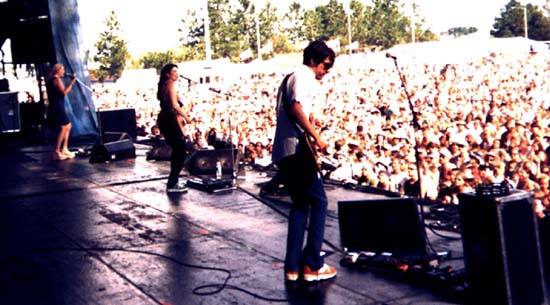
Established artists and rising performers shared space in front of massive crowds, not as exceptions, but as the main draw. The festival created national visibility for artists who might otherwise have been siloed, and it demonstrated that representation and commercial success were not opposing forces.
Its influence extended beyond ticket sales into booking norms and industry conversations, and it became one of the highest-grossing touring festivals of the late 1990s.
Impact through inclusion gives it top-tier placement.
#4 HFStival (A Regional ’90s Music Festival Powerhouse)
HFStival demonstrated the power of regional radio ecosystems in the 1990s. It defined a scene and consolidated alternative culture in a way that felt local but resonated deeply. The early- to mid-’90s HFStival lineups captured that moment in real time. While its footprint was more regional than national, its cultural density and generational loyalty earn it a strong position.
If you grew up in its orbit, it wasn’t just a concert. HFStival was a marker on the calendar and a rite of passage.
Regional dominance still counts, just with slightly less structural weight.
#5 Warped Tour (Punk and Alternative ’90s Festival Culture)
Warped Tour institutionalized youth subculture touring. It created a repeatable, parking-lot-based ecosystem that fused skate culture, pop-punk, and grassroots discovery. Its largest cultural ripple arguably extends into the early 2000s, which places it slightly lower when weighted strictly within a ’90s impact lens.
What started in 1995 as a scrappy summer tour became a pipeline for emerging bands and a proving ground for scenes that rarely saw mainstream festival billing. It smelled like sunscreen and asphalt. It felt DIY, even when it scaled.
Still influential. Just later-peaking.
#6 Tibetan Freedom Concert (Activism and Music in the ’90s)
The Tibetan Freedom Concert fused activism and alternative music at scale. Conceived in the mid-1990s by members of the Beastie Boys during the 1994 Lollapalooza Tour, it brought major artists together in support of Tibetan independence and demonstrated that political advocacy and festival energy could coexist without softening either.
Modeled in spirit after large-scale benefit concerts of earlier decades, it felt urgent rather than nostalgic — a gathering where distortion pedals and political conviction shared the same stage.
While it didn’t create a recurring touring infrastructure like Lollapalooza or Warped Tour did, its symbolic and activist impact earns it a place in the decade’s broader festival story.
Did you know? While major festivals grabbed headlines in the 1990s, parallel touring circuits were building devoted followings at the same time. The H.O.R.D.E. Festival launched in 1992 and helped formalize a jam-band network that would quietly sustain festival culture well beyond a single event.
The Jam-Band Backbone: H.O.R.D.E. and the Rise of ’90s Music Festival Culture
While the biggest festivals defined the headlines of the 1990s, another force was quietly shaping the ecosystem underneath them. The H.O.R.D.E. Festival helped formalize the jam-band touring circuit at a time when alternative rock was surging and radio still drove discovery.
H.O.R.D.E. didn’t have Woodstock’s mud or Lollapalooza’s genre collision, but it helped build something just as important: repeatable, fan-driven touring culture. Acts like Dave Matthews Band and Phish weren’t just festival performers; they were community engines. Their audiences traveled. They followed multiple tour stops. They traded tapes. Shows weren’t just concerts; they were gatherings.
Even the final years of the Grateful Dead cast a long shadow over the decade. When Jerry Garcia died in 1995, it marked the end of an era, but not the end of the culture. Deadhead energy redistributed into emerging touring circuits and helped sustain the improvisational, festival-adjacent ecosystem that defined much of the late 1990s and continues to this day.
Not every cultural shift in the ’90s came from a single branded festival. Some came from bands and fan communities that treated live music as ritual. That infrastructure — portable, loyal, and deeply participatory — made the broader festival boom possible.
What Made ’90s Music Festivals Different?
The best ’90s music festivals weren’t polished products; they were experiments. Some chaotic, some corrective, some visionary. Part of what made 1990s music festivals stand out was how unpredictable and loosely structured they felt compared to today.
Lollapalooza helped mainstream alternative culture. Woodstock ’94 exposed the tension between nostalgia and commercialization. Lilith Fair challenged who the industry believed could headline. HFStival proved regional ecosystems could shape a generation. Warped Tour built youth subculture infrastructure. The Tibetan Freedom Concert showed that activism and arena-scale music didn’t have to be separate lanes.
And beneath all of it, jam-band touring culture reinforced the idea that live music wasn’t just content — it was community.
The 1990s festival era didn’t operate on streaming data, influencer metrics, or algorithmic lineup optimization. It was radio-driven, scene-built, and sometimes gloriously messy. That’s part of why it still resonates.
If you want to explore the broader landscape — including more regional festivals, one-off events, and deeper dives into specific years — you can start with the full guide to 1990s music festivals.
The decade wasn’t defined by a single stage. It was defined by the collision of all of them.
Frequently Asked Questions About ’90s Music Festivals
What was the biggest music festival of the 1990s?
Woodstock 1994 is often cited as one of the largest U.S. music gatherings of the decade, with estimated attendance in the hundreds of thousands. However, “biggest” can mean different things — total attendance, touring reach, or cultural footprint. In terms of long-term influence on the festival model itself, Lollapalooza arguably had broader structural impact.
What were the most popular 1990s music festivals?
The most popular 1990s music festivals weren’t always the biggest — they were the ones that captured the moment. Touring festivals like Lollapalooza brought alternative music to a national audience, while regional events like HFStival built massive local followings. Others, like Lilith Fair and the Tibetan Freedom Concert, stood out for what they represented culturally, not just who was on stage. What made these festivals popular wasn’t just attendance; it was influence. They helped define what live music felt like in the ’90s and shaped the kinds of festivals that followed.
Why were music festivals so popular in the ’90s?
Music festivals became so popular in the ’90s because they offered something that felt bigger than a single concert. For a generation raised on radio discovery and shared cultural moments, festivals brought everything together in one place — multiple bands, different genres, and a sense that you were part of something happening in real time. It was also a moment before everything was curated. You didn’t always know every artist on the lineup, and that was part of the appeal. Festivals felt exploratory, a little unpredictable, and more communal than what came later.
When did Lollapalooza start?
Lollapalooza launched in 1991 as a farewell tour for Jane’s Addiction. During its early 1990s touring era, it helped mainstream alternative rock and established a genre-blending festival template that influenced future events nationwide.
What was Lilith Fair known for?
Lilith Fair, which debuted in 1997, was known for its female-led touring lineup. It challenged industry assumptions about who could headline large-scale events and became one of the most commercially successful tours of its time.
Was Warped Tour a ’90s festival?
Warped Tour began in 1995 and became closely associated with late-1990s youth culture, particularly pop-punk and skate scenes. While its cultural influence extended into the 2000s, its roots are firmly planted in the 90s touring era.
What was the H.O.R.D.E. Festival?
H.O.R.D.E. Festival was a touring festival launched in 1992 that helped formalize the jam-band circuit. It supported the rise of bands like Dave Matthews Band and Phish and contributed to the broader live-music ecosystem of the decade.