
As an Amazon Associate, I earn from qualifying purchases. This post may contain affiliate links.
There was a time when “Want to go to the mall?” was a complete plan.
Not, “What do you need to buy?”
Not, “Which stores are you going to?”
Just… the mall.
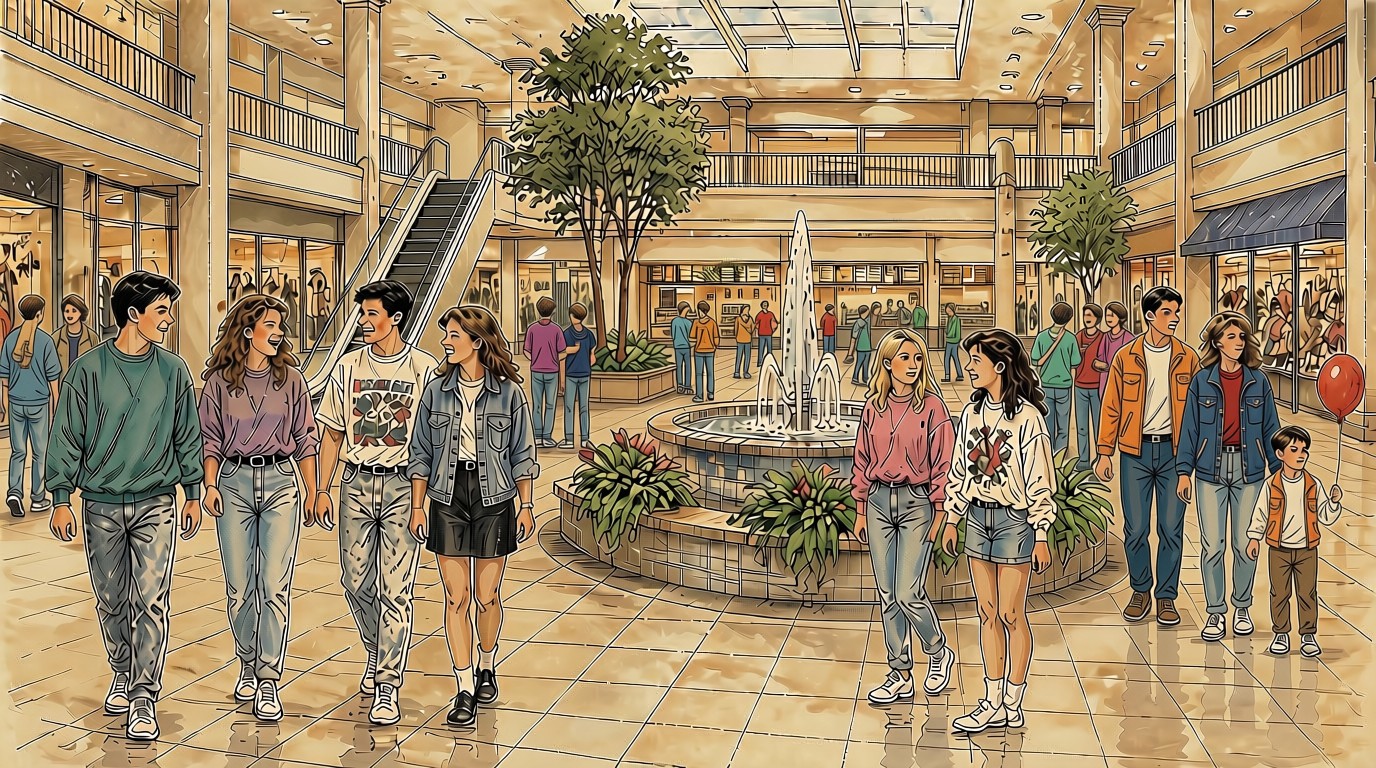
For Gen X, the mall wasn’t simply where we shopped. It was where we spent Saturdays. It was where we met friends, wandered for hours, grabbed fries or a cinnamon roll, caught a movie if the mood struck, and somehow filled an entire afternoon without ever feeling like we needed an agenda.
That’s what feels almost impossible to explain today.
As teenagers, we didn’t think of the mall as a cultural institution. It was simply where life happened. Only now, decades later, can we see that it was one of the last great shared offline spaces before our social lives migrated onto screens.
A Saturday with Nowhere Particular to Be
My earliest mall memories are of Wheaton Plaza in Maryland.
I remember the brown tile. The brown walls. The almost complete absence of natural light. Maybe a few oversized planters breaking up the walkways.
When we were younger, our parents rotated drop-off and pick-up duty. The mall was one of the few places they were comfortable leaving a handful of teenagers for a few hours. We weren’t there to accomplish anything in particular. We were there because it was Saturday.
Saturday mornings often began in front of the TV, but they rarely ended there. Once the cartoons were over, many of us headed out the door in search of something to do. For Gen X, that often meant the mall.
Later, once we could drive ourselves, Montgomery Mall became our regular destination. It was bigger, with two levels, better anchor stores, and seemingly endless places to wander.
We’d pile into one car — usually four or five of us, however many could fit with seatbelts buckled — and spend the next few hours doing what, in hindsight, sounds wonderfully unproductive.
We walked.
The mall wasn’t where we went to do something. It was where we went until something happened.
Did you know? The first enclosed shopping mall in the United States, Southdale Center in Edina, Minnesota, opened in 1956. Designed by Austrian architect Victor Gruen, it introduced the climate-controlled indoor mall that would eventually become a defining part of suburban life for generations of Americans.
Browsing Was the Activity
People sometimes assume we spent the day shopping.
Mostly, we didn’t.
Sure, every now and then someone bought a shirt or a pair of earrings, but window shopping was the main event.
We wandered through Express, Claire’s, Hallmark, The Gap, bookstores, music stores, and dozens of other places with no intention of buying much of anything. We weren’t checking inventory or hunting for deals. We were just seeing what was new while catching up with friends.
Sometimes we’d stop at the food court. Other times we’d catch a movie.
There wasn’t much strategy to it. We followed the same general path because those were the stores we liked, not because we had carefully planned a route. The day unfolded one storefront at a time.
What strikes me now is that the mall wasn’t designed for efficiency. It invited wandering.
Before the Algorithm, There Was a Mall
Today, trends arrive through social media.
In the ’80s and ’90s, they arrived through places, and the mall was one of the biggest.
You saw what people your age were wearing because they walked past you carrying shopping bags. You noticed new styles in store windows. You discovered music in record stores, books on front tables, and whatever everyone suddenly seemed to be wearing after seeing it in a movie or on television.
Before streaming playlists, discovering music was often a physical experience. Record stores in the mall gave us a chance to browse album covers, listen to new releases, and see what everyone else was buying. The same generation that discovered new bands at Sam Goody or Camelot would later pack into the music festivals that defined the ’90s.
Magazines, television, movies, music stores, and malls formed an ecosystem.
Without realizing it, we were all helping shape one another’s tastes simply by occupying the same physical space.
Nobody needed an algorithm to recommend what was popular. Popularity was literally walking around the mall.
For a little while, malls and the early internet coexisted. Before online shopping became the default, many of us still treated the mall as our primary place to browse, discover, and simply spend time — even as the web slowly began changing those habits.
Did you know? Long before smartphones, malls became one of the first places where American teenagers were encouraged to spend time independently. Parents could drop off their teens for a few hours, knowing they’d be indoors, surrounded by other families and shoppers, and able to meet friends in one central location.
The Luxury of Unstructured Time
One of the biggest differences between then and now isn’t shopping. It’s time.
There was no pressure to optimize an afternoon.
Nobody was checking notifications every few minutes or disappearing into separate digital worlds while sitting at the same table. If someone was running late, you waited. If your friends wanted to stop in one more store, you went.
Conversation wasn’t competing with a screen because there wasn’t one.
Looking back, the mall feels like one of the last places where hanging out didn’t require a purpose. In a lot of ways, the mall reflected the same cultural shift we saw in ’90s television. We gradually moved away from simply spending time together toward entertainment that became increasingly personalized and on demand.
“Hanging out” was the purpose.
The Food Court Was Its Own Destination
Every mall had its own version. For me, it was Sbarro, Cinnabon, maybe Taco Bell, all surrounding a big central seating area where people lingered far longer than necessary. The smell of pizza and cinnamon rolls seemed to drift much farther than the food court itself…
Earlier, at Wheaton Plaza, Roy Rogers wasn’t even part of a food court. It was its own restaurant attached to the mall, accessible from both inside and outside. Somehow, fries from Roy Rogers became just as much a part of the afternoon as browsing stores.
Nobody thought twice about sitting around after eating because the tables weren’t just for meals. They were where the conversations continued before everyone headed back into the maze of storefronts.
Seeing the Change Before We Had a Name for It
By the time I worked at GapKids in high school and later at The Gap while attending college in Salisbury, Maryland, I had started noticing subtle changes.
The malls weren’t empty.
They just weren’t quite as busy.
At the time, it didn’t feel like the end of anything. It simply felt different.
Years later, “dead malls” became part of our vocabulary.
I remember watching Frederick Towne Mall slowly hollow out from the inside. Storefronts disappeared one by one while some of the anchor stores remained, almost as if the building itself were refusing to admit the party was over.
The architecture was still there, but the people weren’t. And that turned out to be what mattered most.
Did you know? At their peak in the late 1980s and early 1990s, the United States had roughly 1,500 enclosed shopping malls. Since then, hundreds have closed, been demolished, or been redeveloped into apartments, medical centers, offices, entertainment venues, or open-air shopping centers.
What We Actually Miss
I don’t think Gen X romanticizes malls because we loved shopping. We remember them because they represented something that quietly disappeared.
Revisiting the mall is a lot like revisiting Little House on the Prairie as an adult. The places and stories haven’t changed nearly as much as the perspective we bring to them.
They were inexpensive places to spend an afternoon. They worked in every season and every kind of weather. They gave teenagers independence without putting them completely on their own. Parents knew where we’d be.
Most of all, they gave us shared experiences — not curated ones.
Not personalized experiences — shared ones.
When we remember the mall today, we’re not really remembering the stores. We’re remembering what it felt like to have an ordinary Saturday unfold without a plan.
Nothing extraordinary had to happen.
You wandered.
You talked.
You laughed.
Maybe you bought a shirt.
Maybe you didn’t.
Either way, by the time someone picked you up — or you finally drove home — you’d spent hours together without a single notification interrupting the day.
The mall wasn’t just a place to shop.
It was one of the last great analog spaces where an entire generation learned how to spend time together.



I recently stumbled upon Nostalgic Notebook while researching for my own nostalgic writing and I’m so glad I did! It’s refreshing to find articles that share my love, appreciation, and nostalgia for growing up in the ’80s. I look forward to reading more of your work and revisiting so many great memories through your writing.
Love this! Thank you for stopping by!
Hi Liza,
I’m Facebook friends with your mom and dad. I enjoyed your article here and can relate to being a parent during that time, making the trip from Huntsville to College Station, so my daughter in her teen years could enjoy the mall and give us both our own experience.
I’m going to share this with her. I know she’ll have some sweet memories triggered by your wonderful writing. Thank you for the trip down memory lane.
You’re very welcome — so glad you’re enjoying it!