As an Amazon Associate, I earn from qualifying purchases. This post may contain affiliate links.
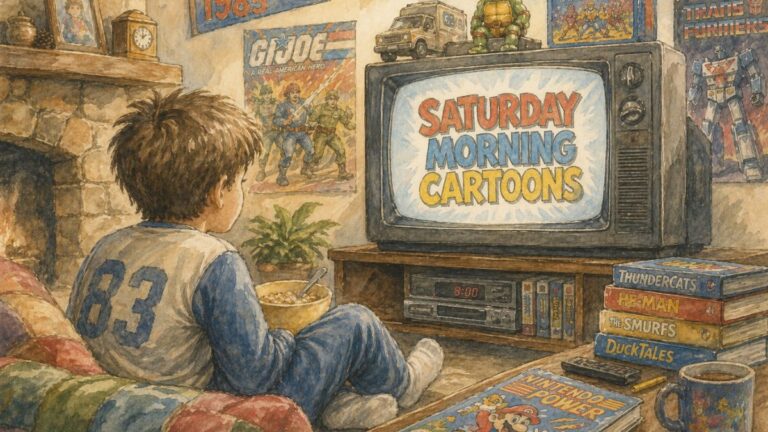
By the time you were fully awake on a Saturday morning, the cartoons had already started.
Something was always on when you wandered in — half-watched, half-heard, part of the background while you poured cereal or negotiated over what stayed on next. And then, every once in a while, something would pull you all the way in.
Not every cartoon lived in the same category. Some were comfort. Some were appointment viewing. Some were a little chaotic in a way that didn’t quite make sense but felt right at 8:30 a.m.
This isn’t meant to be exhaustive, and it’s not a strict ratings-based ranking. It’s a mix of the biggest cultural staples, plus the reruns that never really left. It’s what Saturday mornings actually felt like — and the shows that defined how they actually worked.
Here’s how they break down, based on how we actually watched them.
The Cartoons That Were Always On
Easy to drop into. Hard to turn off.
The Smurfs (1981-1989)
Soft, predictable, and quietly strange if you think about it too long. Not appointment viewing, but always acceptable to leave on, and that counted for a lot. The stakes were low, the pacing was slow, and that was part of the appeal — it gave Saturday mornings a kind of breathing room.
Watch: Smurfy Confidence 💪 • The Smurfs
The Smurfs were rarely appointment viewing — but they were almost always on. Episodes like this filled the space between the shows you planned around. Even the storyline “Smurfy Confidence” fits the tone: simple, familiar, and easy to settle into without overthinking it.
Video via The Smurfs • Official Channel! via YouTube
Alvin and the Chipmunks (1983-1990)
Bright, musical, and just chaotic enough to hold your attention without requiring it. You could tune in and out and never feel like you missed anything. The songs, the quick segments, the constant motion — it was built for partial attention.
The Care Bears (1985-1988)
Gentle to the point of almost being background noise, but in a comforting way. Less about plot, more about tone. It wasn’t trying to compete with louder shows and instead just existed alongside them, which made it easy to keep on.
The Ones You Actually Planned Around
You sat down for these — and stayed.
Teenage Mutant Ninja Turtles (1987-1996)
Loud, fast, and fully committed to its own energy. One of the few shows that consistently pulled everyone in, regardless of age. The mix of action and humor made it feel bigger than the time slot it lived in.
Batman: The Animated Series (1992-1995)
Darker, more cinematic, and clearly operating on a different level. Even as a kid, you could tell this one was doing something more. The storytelling felt tighter, the tone more serious — it asked for your attention and rewarded it.
Did you know? Batman: The Animated Series is often cited as one of the greatest animated TV shows ever made, known for its noir style and orchestral score.
X-Men: The Animated Series (1992-1997)
Serialized before that was really the norm. The stakes carried over, and missing an episode actually felt like missing something. It introduced a level of continuity that made the whole block feel more connected.
Did you know? X-Men: The Animated Series helped popularize multi-episode story arcs in kids’ TV — now a standard in modern streaming shows.
The Ones That Felt Slightly Unhinged
Fast, weird, and a little unpredictable in the best way.
Pee-wee’s Playhouse (1986-1990)
Not a traditional cartoon, but it lived in the same space — and felt like flipping between channels inside someone else’s brain. The mix of live action, animation, and randomness made it impossible to fully anticipate, which was part of the draw.
Watch: Pee-Wee’s Playhouse Theme (1987-1990)
If cartoons like The Smurfs filled the background, Pee-wee’s Playhouse pulled you in immediately. From the first few seconds, it felt like stepping into something louder, stranger, and a little unpredictable.
Video via Barbara Long on YouTube
Garfield and Friends (1988-1994)
Dry humor mixed with complete absurdity. Grounded in Garfield, but fully willing to go off the rails. The contrast between the slower Garfield segments and the chaos of U.S. Acres gave it a rhythm that felt different from everything else.
Animaniacs (1993-1998)
Quick, self-aware, and layered with jokes you didn’t fully get yet — but knew were there. It moved fast enough that even if you missed something, it didn’t matter because another joke was already coming.
The Action Block (and the Toy Aisle Tie-In)
Momentum, stakes — and a reason to want the characters afterward.
G.I. Joe: A Real American Hero (1983-1986)
Clear heroes, clear villains, and stories that reset — but still felt urgent in the moment. It followed a formula, but the consistency made it easy to jump in anywhere and know exactly what you were getting.
Transformers (1984-1987)
Part spectacle, part story. You didn’t need to follow every detail — the transformations were enough. The plot often took a back seat to the visuals, which was exactly the point.
He-Man and the Masters of the Universe (1983-1985)
Big declarations, simple morals, and a scale that felt larger than life. Every episode built toward a clear lesson, but it was the intensity and repetition that made it stick.
Did you know? Many ’80s action cartoons were developed alongside toy lines, following regulatory changes that made character-based merchandising a central part of kids’ TV.
The Retro Cartoons That Never Left
Not new — but always there.
These weren’t part of the ’80s and ’90s wave, but they were still everywhere — reruns, syndication, filling space between newer shows. Over time, they felt just as much a part of Saturday mornings as anything current.
Looney Tunes
Fast, chaotic, and endlessly rewatchable. The pacing felt sharper than newer cartoons, with jokes landing quickly and often. It didn’t matter when you tuned in — you were immediately in it.
The Flintstones
Familiar to the point of being ambient. You didn’t plan to watch it, but you often did anyway. It felt more like something you lived alongside than something you followed closely.
The Jetsons
A version of the future that already felt slightly outdated — and somehow more interesting because of it. It had a slower pace, which made it easy to drift in and out.
Scooby-Doo, Where Are You!
Formulaic in the best way. You knew exactly how it would play out, and that predictability was part of the draw. The repetition didn’t wear out — it became the point.
Did you know? Classic cartoons from the ’60s and ’70s remained in heavy rotation through the ’80s and ’90s, meaning Gen X often grew up watching multiple eras of animation at once.
The Ones You Didn’t Plan to Watch — But Did
Somewhere between background and must-watch.
DuckTales (1987-1990)
Adventure-driven and smarter than it needed to be. It blurred the line between weekday and Saturday viewing, but once it was on, it was hard to leave. The storytelling gave it a sense of momentum that kept you watching longer than you meant to.
Rugrats (1991-2004)
Slower, more observational, and focused on perspective rather than action. It stood apart by dialing everything down and letting the small moments carry the story.
Doug (1991-1994)
More internal and low-key. It didn’t try to match the energy of everything around it, which made it stand out in a different way. It was the kind of show you noticed more in hindsight than in the moment.
Back then, it wasn’t just which cartoons were “the best.” It was how they fit into the morning flow.
Some were there while you were waking up. Some pulled you all the way in. Some just filled the space in between.
And that mix is part of why they still hold up now — not just as shows, but as a specific kind of experience — one where your attention came and went, but the feeling of being there stayed. It’s part of why these cartoons mattered in the first place.
Frequently Asked Questions About Saturday Morning Cartoons
What were the most popular Saturday morning cartoons in the ’80s and ’90s?
Some of the most widely recognized include Teenage Mutant Ninja Turtles, Transformers, The Smurfs, X-Men, and Batman: The Animated Series.
Why were Saturday morning cartoons so popular?
They were one of the few dedicated blocks of kids’ programming on network TV, creating a shared weekly routine before cable and streaming changed viewing habits.
Are Saturday morning cartoons still a thing?
Not in the same way. Most programming has shifted to cable and streaming, which changed both the schedule and the shared experience.