
As an Amazon Associate, I earn from qualifying purchases. This post may contain affiliate links.
There was something about waking up early on a Saturday that felt different.
Not forced or rushed, like a school day. Just… intentional.
For a lot of us, Saturday morning cartoons in the ’80s and ’90s started in that quiet hour when the house hadn’t fully woken up yet, but you had — usually somewhere in the six o’clock range. Not because you had to, but because you wanted to.
And that alone made it feel like yours.
A Time That Belonged to Kids
During the week, mornings had boundaries. You got up, got ready, and maybe — if your house was like mine — the TV stayed off entirely.
Saturday broke that pattern.
You’d head downstairs, turn on the TV, and settle in. No permission needed, no real plan beyond whatever the networks had lined up. It wasn’t just that cartoons were on — it was that this block of time existed for them, and for you.
It wasn’t exactly alone time. Parents were around somewhere, not sleeping in, but not part of it either. It was more like a pocket of independence — a few hours carved out that felt like they belonged entirely to kids.
And that feeling carried as much weight as the shows themselves.
The Setup Was Always the Same
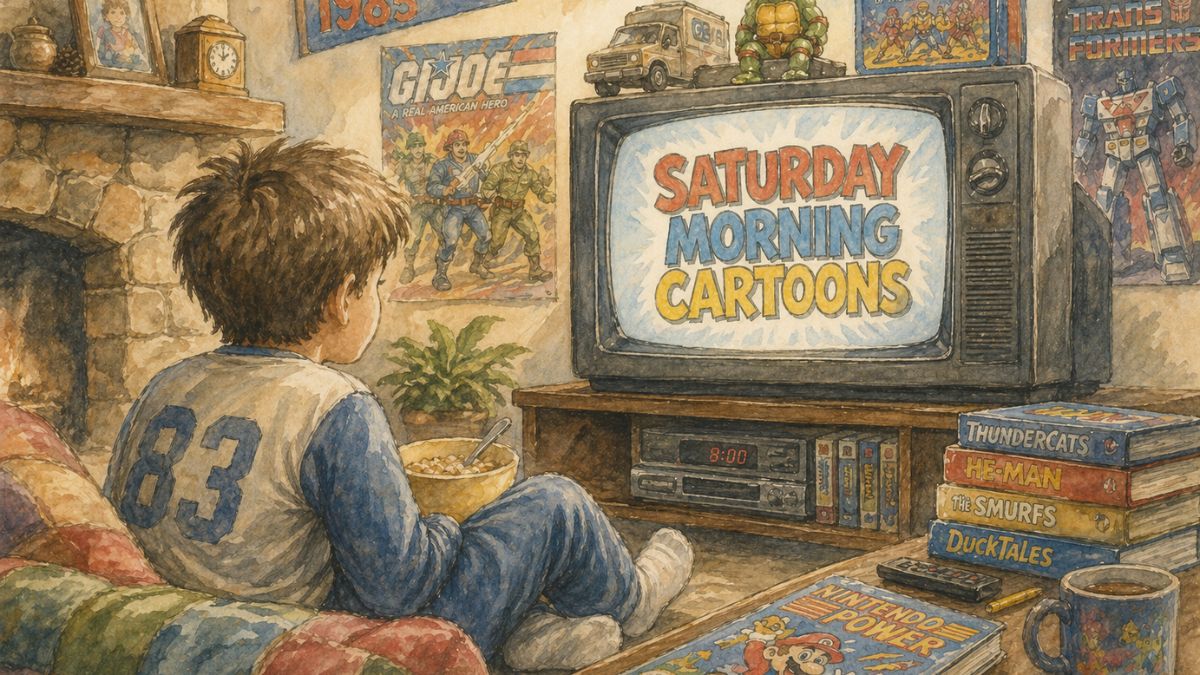
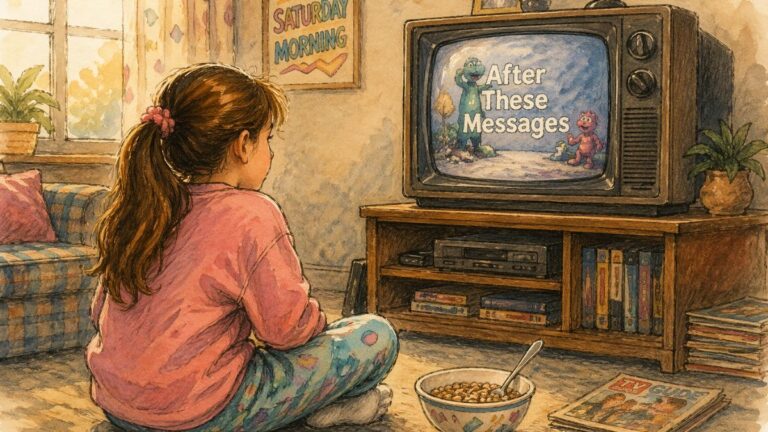
Pajamas still on, a blanket pulled around you, lamps on low — just enough light to see the room without breaking the mood.
The TV came to life before anything else did.
Maybe there was cereal — sometimes at the kitchen table, sometimes balanced on a TV tray in the living room. Not quite the free-for-all of eating on the floor, but close enough to feel like a break from the usual rules.
And then there was the room itself and the details you didn’t think about at the time but remember now.
The way the carpet felt. The faint smell of a wood-burning fireplace lingering in the background. The quiet of a house that hadn’t fully started its day yet.
It wasn’t just watching TV. It was a whole environment.
You Were Locked In — And That Mattered
Once the TV was on, you were in it.
This wasn’t background noise, at least not at first. You were paying attention — fully. Shows came on at specific times, in a specific order, and if you missed them, you missed them.
There was no catching it later. No streaming. No rewinding.
Even if a book made its way into your hands later in the morning, the cartoons were still the anchor and the thing everything else worked around.
And that kind of focus almost feels foreign now.
Did you know? In the late 1980s, the major networks programmed up to three to four consecutive hours of Saturday morning cartoons — a dedicated block that didn’t really exist anywhere else in the week.
That structure wasn’t accidental. It trained us to show up.
The Rhythm of It All
There was a rhythm to Saturday mornings that didn’t exist anywhere else.
You had your early shows, the ones you caught right when you turned the TV on. Then the mid-morning favorites, followed by the slow taper into late morning, when things started to feel different.
Sometimes the lineup shifted, or neighborhood friends started showing up. Either way, the spell started to break.
You could feel it ending before it actually ended.
At some point, the rest of the house caught up. People were moving around more. Plans started forming. The TV may have stayed on, but you weren’t watching it the same way anymore.
And that transition — from something that felt fully yours to something shared — was part of the experience, too.
Did you know? By the early 1990s, networks were competing heavily for Saturday morning ratings, often promoting their cartoon lineups weeks in advance to lock in young viewers.
We didn’t think about ratings at the time, but we felt the consistency.
When It Started to Shift
Like most things from that era, it didn’t end all at once.
It just… changed.
Getting older played a role. Interests shifted and the shows didn’t hit the same way. And in a lot of houses, younger siblings stepped in and quietly took over the TV, choosing what was on and reshaping the lineup.
You might still be in the room and glance up from time to time, but it wasn’t yours in the same way anymore.
What had once been appointment viewing slowly became background noise.
Why It Still Sticks
It’s easy to look back at ’80s and ’90s cartoons and focus on the shows and their characters, theme songs, and animation styles.
But what made Saturday morning cartoons stick wasn’t just what we watched, it was how we watched.
The routine, the quiet, the feeling of waking up early for something you actually wanted to do. The sense that, for a few hours, there were no interruptions and no expectations.
Just you, a blanket, a bowl of cereal, and whatever was on next.
That kind of experience doesn’t really exist in the same way anymore, and that’s why it stays with you.
Did you know? The decline of Saturday morning cartoons on major networks accelerated in the late 1990s and early 2000s, as cable channels like Cartoon Network and Nickelodeon — along with changing advertising regulations — shifted how and when kids watched cartoons.
If you want to revisit the shows themselves, you can head back to “Saturday Morning Cartoons in the ’80s and ’90s — What Made Them Stick.”
And if you remember the other side of weekend TV — the unexpected shift into after-school specials and PSAs — that’s its own shared experience worth revisiting, too.



I can relate, even though I’m a kid of the 70s. Looney Tunes (the unadulterated versions), Pink Panther, Scooby Doo (without Scooby Dum or Scrappy Doo), Fat Albert & The Cosby Kids (imagine a cartoon with that title today!), Schoolhouse Rock and various others. Saturday mornings were almost sacred as church on Sundays!
Love this! Even as a child of the ’80s (though was born in the ’70s), I remember all those shows fondly. And you’re not wrong about the titles then vs. now!